Class record
Transmuter
- Tier
- 1
- Difficulty
- 2 / 5
- Roles
- MainArtisanSecondaryUtility
Entry
Requirements
None
Advancement
Progression
- UnlockKey ability
- Level 2Ability 1
- Level 3SkillsYou gain 5 Transmuter points. Pick one of the crafting disciplines, such as blacksmithing or alchemy. Whenever you use your Transmuter abilities in a craft of that discipline, you may add your transmuter points as bonus to that ability (even if it's not a roll).
- Level 4Ability 2
- Level 5HeartYou gain +1 to Reason.
- Level 6Ability 3
- Level 7SoulYou gain +1 to Focus, Power, Agility or Toughness. In addition, as an errand you can use Co-Craft to help in crafting once. Only 1 person can Co-Craft with a craft at a time. When you Co-Craft, you help another crafter allowing you to use a single Co-Craft ability in their crafting session. Your Co-Craft actions count towards the 1 limit of using an ability for the main crafter. (Both you and the main crafter cannot use the same co-craft ability in one crafting session). You must declare you are helping before any crafting actions are taken by the main crafter.
- Level 8Ultimate ability
Identity & lore
Class overview
In the dust of an artisan's workshop or in the open clearings of a logging company, the hum and chirps of transmutation can be heard. Transmutation is an art, a magic as ancient as Lyr. Long before the shadows of the great calamity, Transmuters were scholars who questioned the very nature of existence. This pursuit led to a mastery over both destruction and creation, spinning the threads of reality itself into a tapestry.
Transmutation is the second branch of alchemy and created a revolution in society. It replaced primitive methods such as smelting and manual refinement—which previously had artisans sweating over blazing crucibles into the dark hours of the night. It isn't uncommon for master craftsmen to have a Transmuter in their employ or as a partner, processing material in the atelier or even helping with the crafting itself. In fact, nowadays there is rarely a town across Lyr without at least one person versed in the basics of this ancient art.
Transmuters manipulate matter at its core, unraveling its threads and rebuilding them into entire new forms. They can shatter stone into dust, or create small figurines from blocks of wood. The control of Transmutation is only limited by skill and imagination. Transmutation is the second branch of Alchemy, which itself is one of the great pillars of Arcane Magic.
Yet with great power comes great peril. Those who understand Transmutation know that creation and destruction are two sides of the same coin. It requires a sound mind and body to walk the delicate balance, making Transmuters some of the most respected Artisans in any community they are in.
Tactical guidance
Playing Transmuter
Transmuter is a class that helps crafting for other classes and provided utility in combat.
Transmute weapon is a simple ability that lets you create a weapon for yourself or ally. While you probably don't want to rely entirely on this for your equipment as it costs mana and may not always work, it's good for providing an emergency backup or if there happens to be special material nearby.
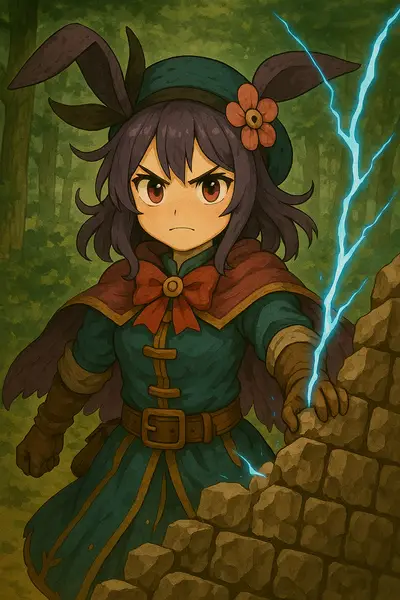
Transmute wall is a reactionary defense against a ranged attack. Because you'll be able to see the damage you're about to take in most cases, it will be easy to judge how much mana you should spend on this. Because it's a wall and not you blocking, this can help you defend against full pierce type of attacks.
Transmute terrain is a versatile ability that lets you create walls, bridges, ledges and other terrain. You can spend a lot of mana on this at once, allowing for some creative use such as completely boxing in a character, pushing yourself 60ft into the air for a sniper position, pushing enemies off a cliff and much more.
Deconstruct is an interlude ability that lets you recycle useless items into usable material. Best to use it when you have a large amount of things piled up.
In crafting, you have a few unique abilities as well as the ability to co-craft. This costs you nothing to do by default, so use it whenever you can. Two of your co-craft abilities do have a cost and you can also use them in your own crafts. Temperature Shock is useful early when you roll poorly to have a guaranteed number to your next roll. Once your bonus grows higher or if you need to gamble, Alchemic catch will be better as it uses the full bonus you have. If you're co crafting and don't want to spend money, you can just use bouncing ideas for a free small bonus. Finally ragequit is useful if you don't care about profit by itself and only want to make something big. You do lose a lot when using this, so avoid it unless you know what you're doing.